
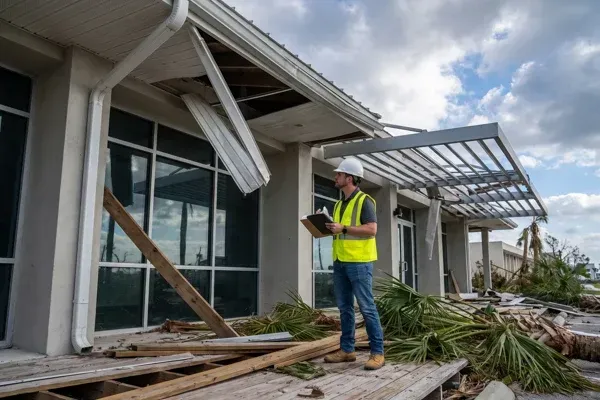
Post-Storm Structural Evaluation in Tampa: When You Need One
By Judian Duran, PE, StS-1, Founder and Principal Structural Engineer, Duran Structural. Last updated August 2026.
On August 6, 2026, NOAA held its Atlantic outlook at below normal: 7 to 13 named storms, 2 to 6 of them hurricanes, and a 75% chance the season finishes under an average year (NOAA, 2026). Read the next line too, the one that matters to a building owner: the outlook “is not a landfall forecast.” A quiet season and a quiet Tampa Bay are two different things.
A post storm structural evaluation is what you order once the forecast stops being the question and the building in front of you starts being it. This guide covers when you need one, what an engineer checks that a roofer or adjuster won’t, what the colored placards mean, and how the 50% rule and Florida’s claim deadlines can quietly set your repair budget.
Key Takeaways
- NOAA says a seasonal outlook “is not a landfall forecast,” and NWS Director Ken Graham advises owners to “prepare for every storm that’s projected to impact your area” (NOAA, 2026). One storm is a season.
- Storm surge is currently the leading cause of hurricane fatalities, and storm tide can reach 20 feet or more before wave action is counted (NOAA National Hurricane Center). It damages foundations and connections in ways wind doesn’t.
- If repairs reach 50% or more of your building’s pre-damage market value, your community can declare it substantially damaged and require compliance with current flood rules (FEMA). That happens at permit application.
- Florida bars notice of a property insurance claim after 1 year from the date of loss, and a supplemental claim after 18 months (Fla. Stat. 627.70132). Documentation you skip in week one is often unrecoverable.
What is a post-storm structural evaluation?
It’s a licensed engineer’s assessment of whether a building’s structural system still does its job after a windstorm or flood, and what it takes to restore it. The engineer examines the load path from roof to foundation, identifies damage that changes capacity, and issues a signed and sealed report an owner, insurer, lender, or building department can act on.
That’s narrower and deeper than a damage walkthrough. A roofer tells you the roof is torn. An adjuster prices what’s visible. An engineer answers a different question: what can this structure carry now, and what has to change before people use it again?
Our post-storm structural assessment practice exists because that question doesn’t answer itself from photos. No evaluation makes a damaged building safe, and no engineer can promise an outcome. What it does is replace guesswork with measurements, analysis, and a documented opinion.
Why does a hurricane need an engineer and not just a contractor?
Because wind and water attack the parts of a building you can’t see. Roof-to-wall connections, shear walls, diaphragm nailing, column bases, and foundation bearing all sit behind finishes. Surge adds a problem contractors rarely assess: soil under footings can wash out while the walls above look untouched.
Storm surge is currently the leading cause of fatalities from hurricanes, and storm tide can reach 20 feet or more before wave action on top is counted (NOAA National Hurricane Center). Water that high doesn’t just wet a building. It applies lateral pressure, buoyancy, debris impact, and scour. Those are load cases, not cleanup items.
The National Weather Service’s Tampa Bay office ranks 2024’s Helene and Milton among the most impactful storms to hit Florida’s west coast in the past hundred years, citing historic surge, record river levels, and some of the highest local wind speeds on record (NWS Tampa Bay). That’s why coastal engineering and post-storm work are one conversation here.
| What you see | What it may mean | Who should look |
|---|---|---|
| Missing roof covering, exposed sheathing | Uplift damage at roof-to-wall connections | Engineer, before reroofing closes it up |
| Doors and windows suddenly binding | Frame racking or foundation movement | Engineer |
| Diagonal cracking at corners and openings | Lateral load damage to the shear system | Engineer |
| Water lines above the slab | Flood loading, saturated framing, possible substantial damage | Engineer plus your floodplain administrator |
| Soil washed out at a footing, seawall, or slab edge | Scour and loss of bearing or lateral support | Engineer, urgently |
| Sagging floors or a bowed exterior wall | Load path compromised, capacity reduced | Engineer, and restrict occupancy |
| Torn screening, fence, lost shingles only | Nonstructural in most cases | Contractor and your adjuster |
What do the green, yellow, and red placards on a building mean?
They’re a rapid triage result, not a final verdict. Post-disaster safety evaluations after wind and flood commonly follow the ATC-45 field manual, which produces three posted placards: green INSPECTED, yellow RESTRICTED USE, and red UNSAFE (Applied Technology Council). Each reports what a fast field screening concluded, and nothing more.
Rapid evaluation runs minutes per building. The detailed evaluation that supports a repair scope, a permit, or an insurance position takes far longer and produces calculations.
| Placard | What it says | What it does not say | Next step |
|---|---|---|---|
| Green: INSPECTED | No apparent hazard in rapid screening | That concealed damage was ruled out | Detailed evaluation if it took surge or major wind |
| Yellow: RESTRICTED USE | Entry or use should be limited | Which repairs lift the restriction | Detailed evaluation and a repair scope |
| Red: UNSAFE | Do not enter or occupy | That the building must be demolished | Evaluation, shoring plan, building official coordination |
Does a red tag mean you’ve lost the building? Usually not. Plenty of red-tagged buildings come back after shoring, targeted repair, and re-evaluation. Just don’t mistake the tag for the analysis.
How does the 50% rule change your repair decision?
It can change the entire project. If your community determines repairs will cost 50% or more of the building’s pre-damage market value, the structure is substantially damaged and must be brought into compliance with current floodplain requirements (FEMA). Land value is excluded, and the call is made locally, not by FEMA (FEMA).
In Hillsborough County the calculation is formalized. The county requires a substantial improvement and damage worksheet, a signed contractor and owner attestation including overhead and profit, a cost breakdown, and a market value from the property appraiser or a current appraisal of actual cash value (Hillsborough County). Costs accumulate over a 12-month window, so a repair and a planned renovation can cross the line together when neither would alone.
So the engineering scope and the permitting strategy have to be built together. Raising the building, relocating it, or floodproofing a non-residential structure may qualify for Increased Cost of Compliance coverage up to $30,000 under an NFIP policy once a substantial damage declaration exists (FEMA). Owners weighing rebuild against restoration usually find the answer here, not in the photos. Historic buildings run through historic preservation and structural restoration.
If the repair becomes a rebuild, a coastal flood report sets the floor elevation before design starts.
What does a licensed structural engineer actually check?
Three systems, in this order: the vertical load path, the lateral force-resisting system, and the foundation and soil supporting both. Everything else on a damage list is downstream of those. In the field that means checking roof-to-wall and wall-to-foundation connections rather than roof covering, reading cracking patterns that show the shear system took load, probing for saturated or delaminated framing, and examining grade around footings, slabs, and seawalls for scour. On commercial and institutional buildings, add long-span framing, canopies, rooftop equipment supports, and facade attachment.
“On a task force deployment you learn to read a building fast, and you learn that the damage that hurts people is usually the damage nobody photographed. I’m not looking at what the storm took off the building. I’m looking at what it took out of the load path.”
- Judian Duran, PE, StS-1
I’m a Structures Specialist (StS-1) on Florida Urban Search and Rescue Task Force 3, so my post-storm work started in damaged and collapsed structures, not an office. That training sets how our team sequences an evaluation: life safety and access first, capacity second, repair design third. It carries into the structural assessment and peer review we do when an owner wants a second opinion on someone else’s damage report, and into forensic structural engineering when cause of loss gets contested.
Need a building looked at now? Call (813) 536-8002 or contact Duran Structural. We serve Tampa Bay and all of Florida, led by an engineer with 100+ projects across over a decade.
How fast do you have to act after a Tampa storm?
Faster than most owners expect, and the binding deadlines are legal rather than structural. Florida bars a property insurance claim or reopened claim unless notice was given within 1 year of the date of loss, and a supplemental claim after 18 months (Fla. Stat. 627.70132). Those clocks start at the storm, not when you find the damage.
| Action | Timing | Why it matters |
|---|---|---|
| Photograph and document conditions | Immediately, before cleanup | Evidence goes out with the debris |
| Engineering evaluation | Days, not months | Repairs cover concealed damage |
| Notice of claim or reopened claim | Within 1 year of date of loss | Statutory bar (627.70132) |
| Supplemental claim | Within 18 months of date of loss | Statutory bar (627.70132) |
| Substantial damage determination | At repair permit application | Can require full flood compliance (FEMA) |
| Increased Cost of Compliance claim | After a substantial damage declaration | Up to $30,000 under an NFIP policy (FEMA) |
The sequencing trap is simple. Emergency repairs close up the exact connections an engineer needs to see, and once a wall is closed the argument about what the storm did becomes an argument about opinions. Get the evaluation before the drywall does.
Frequently Asked Questions
How much does a post-storm structural evaluation cost in Tampa?
Fees depend on building size, structural system, and whether you need a rapid opinion or a sealed report with calculations and repair drawings. A single-family evaluation and a hospital campus aren’t comparable. We break down how fees get scoped in our guide to structural engineering costs in Tampa, and we quote per building.
Will my insurance company pay for a structural engineer?
Sometimes, depending on your policy and the carrier’s scope. Either way, an engineer’s sealed report is often the document that moves a disputed claim, and Florida bars claim notice after 1 year from the date of loss (Fla. Stat. 627.70132). Waiting on approval before documenting damage is the expensive choice.
My building has a green placard. Do I still need an evaluation?
If it took surge, flood, or significant wind, yes. A green INSPECTED placard reflects a rapid screening that found no apparent hazard (Applied Technology Council). It isn’t a detailed engineering evaluation and doesn’t rule out concealed connection or foundation damage. Triage and a sealed report are different products.
What counts as substantial damage in Hillsborough County?
Damage of any origin where restoring the building to its pre-damage condition would cost 50% or more of its market value before the damage. Hillsborough County requires a worksheet, a signed contractor and owner attestation, a cost breakdown, and an appraisal-based market value (Hillsborough County). The call is made locally at permit application.
Can you evaluate commercial and healthcare buildings, not just houses?
Yes. We work across residential, commercial, and healthcare and institutional structures, from small buildings to high-rise, in steel, concrete, masonry, and wood. Post-storm scopes for occupied institutional buildings usually run alongside phased reoccupancy planning, because partial use has to continue during repair.
The short version
A post-storm structural evaluation buys three things a damage estimate can’t: a defensible account of what the storm did to the load path, a repair scope built around the 50% rule instead of surprised by it, and a sealed document insurers, lenders, and building officials accept. It doesn’t guarantee a damaged building is safe. It tells you, in writing, what the structure can carry and what has to change.
If a storm has touched your building in Tampa Bay, get an engineer through it before repairs cover anything up. See our post-storm structural assessment service, browse our services and resources, read about the firm, or get in touch and we’ll tell you honestly whether you need us this week or after the queue clears. If the job turns into rebuilding, renovations and additions is the next stop.
Judian Duran, PE, StS-1 is the founder and principal structural engineer of Duran Structural, a boutique Tampa firm serving all of Florida and the Southeast. He’s a licensed Professional Engineer in Florida, North Carolina, Georgia, and Alabama with over a decade of experience across 100+ projects, including eight years as a project engineer at Thornton Tomasetti. As a Structures Specialist (StS-1) on Florida Urban Search & Rescue Task Force 3, he leads Duran’s post-storm assessment work, and he serves as Vice President of the ASCE West Coast Branch and president of the FSEA Bay Area chapter. He also sits on the ASCE 24 Flood-Resistant Design committee and is a contributing author to FEMA P-2345, the Building Designer’s Guide to Calculating Flood Loads Using ASCE 7-22 Supplement 2.
This article is general information, not project-specific engineering advice. Consult a licensed engineer for your specific structure.
