
Foundation Cracks: When to Worry (Florida Guide 2026)
By Judian Duran, PE, StS-1 - Founder & Principal Structural Engineer, Duran Structural. Last updated August 2026.
If you’re reading about foundation cracks and when to worry, you probably just found one and you’d like a straight answer. Here’s the honest one: most cracks in a house aren’t structural. A National Association of Home Builders guide written by a licensed engineer puts it plainly, noting that “structural distress does cause cracks, but the vast majority of cracks are not structural in nature” (NAHB Builder Education Series).
That’s the reassuring half. The other half matters just as much: a small number of cracks are the first visible sign that the ground under your house is moving, and those deserve a real look rather than a coat of caulk. This guide walks through which patterns are usually cosmetic, which ones change the answer, and what Florida’s ground conditions actually mean for a homeowner in Tampa Bay.
Key Takeaways
- Width alone doesn’t decide it. A widely used engineering guideline treats cracks from hairline up to 1/8 inch as “negligible to slight,” 3/16 to 9/16 inch as “moderate,” 9/16 to 1 inch as “severe,” and over 1 inch as “very severe” (NAHB Builder Education Series, citing Day, 2011).
- What raises concern is a crack plus something else: vertical offset across the crack face, doors and windows that stick, or floors that have gone out of level (NAHB).
- Not every depression in Florida is a sinkhole. The state’s own subsidence database names broken sewer and drain pipes, compressing organic layers, poorly compacted fill, and buried debris among the common non-sinkhole causes (Florida DEP).
- Movement is measured over time, not in a single glance. Date and photograph the crack, then have a licensed engineer look at it if it’s growing, offset, or paired with other symptoms.
Which foundation cracks should you worry about?
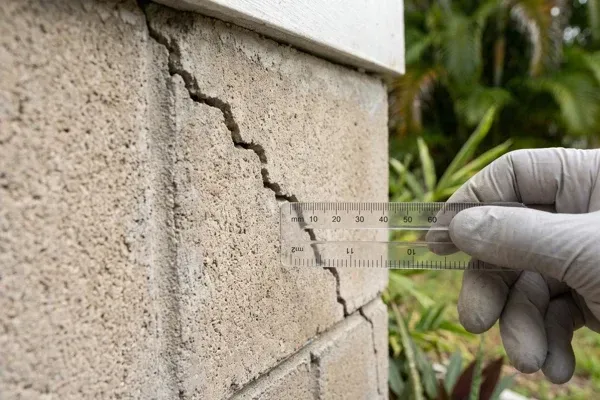
Worry about cracks that are doing something, not cracks that simply exist. The pattern that concerns an engineer is a crack that is widening month over month, that has vertical displacement across its face (one side sitting proud of the other), or that shows up alongside sticking doors, sloping floors, or a wall that’s no longer plumb. The NAHB guide is direct about this: “Cracks alone are not necessarily indicative of a structural concern,” but they’re “more likely to be a structural concern if accompanied by other indications of structural distress, such as inoperable doors and windows or excessively sloping floors and surfaces.”
Width still helps you sort, and it’s worth knowing the scale engineers actually use rather than a number off a repair company’s website. The bands below come from a general engineer’s guideline in Forensic Geotechnical and Foundation Engineering (Day, 2011), as published by NAHB.
| Crack width | Damage classification |
|---|---|
| Hairline up to 1/8 inch | Negligible to slight |
| 3/16 to 9/16 inch | Moderate |
| 9/16 to 1 inch | Severe |
| Over 1 inch | Very severe |
Treat that as a sorting tool, not a verdict. A 1/16 inch crack with a step in it can matter more than a 1/4 inch crack that has sat unchanged for a decade.
What do different crack patterns actually mean?
Shape tells you more than size. A crack follows the path of least resistance through a brittle material, so the direction it runs, and whether the two faces have moved relative to each other, points toward the cause. Use the reference below as a first read on what you’re looking at, then confirm it with someone who can measure.
| Crack pattern | Likely cause | Concern level | What to do |
|---|---|---|---|
| Fine, random, map-like cracks in a slab | Concrete shrinking as it cures and dries | Low | Note it. Slab shrinkage cracks are “expected and very common” (NAHB) |
| Thin vertical crack, even width, no offset | Shrinkage or minor early settlement | Low | Photograph and date it, recheck in 3 to 6 months |
| Diagonal crack off a window or door corner | Openings act as stress-relief joints | Low to moderate | Monitor for widening or a step forming |
| Stair-step crack through mortar joints | Differential settlement under part of the foundation | Moderate | Evaluate if it’s growing or the wall is out of plane |
| Crack with vertical offset, one side proud | Real movement, not just shrinkage | Higher | Have a licensed engineer assess it |
| Horizontal crack with bowing or leaning | Lateral pressure on the wall | Higher | Assess promptly, don’t load the wall |
| A crack measurably wider than last season | Ongoing ground movement | Depends on rate | Document the rate, then have it assessed |
| Cracks plus sticking doors or sloping floors | The structure moving as a unit | Higher | Assess. The state names these as “major signs of foundation damage” |
| Cracks near a new dip in the yard, slab, or drive | Subsidence, soil raveling, or a broken pipe | Higher | Assess, and consider reporting the depression |
| Several cracks appearing at once after heavy rain | Rapid moisture change in the ground | Moderate to higher | Assess soon |
One caution about that last row. Florida’s biggest documented sinkhole outbreak followed exactly that pattern: record rainfall from Tropical Storm Debby in June 2012, arriving after an extended drought, triggered hundreds of collapse sinkholes statewide (FGS / Florida Division of Emergency Management, 2017).
Why does Florida ground crack foundations differently?
Because most of Florida sits on soluble rock. The state is underlain by “several thousand feet of carbonate rock, limestone and dolostone, with a variably thick mixture of sands, clays, shells, and other near surface carbonate rock units, called overburden,” and sinkholes form when that overburden subsides or collapses into cavities dissolved in the rock below (FGS / FDEM, 2017). USGS names Florida first on its list of states that see the most damage from sinkholes (USGS).
Two other conditions matter, and one gets misreported constantly. Expansive clay is real in Florida, but it isn’t the statewide story it is in Texas. The state’s geologists point to the smectite clays of the Hawthorn Group, which “occur near the surface in many parts of north Florida” (Florida DEP). Organic soils are the more common Tampa Bay problem: buried organic matter can oxidize and compress, producing slow sinking that damages foundations. Groundwater ties it together, since aquifer levels help support the ground above and sharp swings change how it behaves.
“Homeowners tend to ask me whether a crack is bad. The more useful question is whether it’s moving. A stable crack and a moving crack can look identical on the day you find them, and only measurement separates them.” - Judian Duran, PE, StS-1
Is my foundation crack a sinkhole?
Probably not, and the state’s own data explains why. Florida keeps a Subsidence Incident Report database, and the FGS is careful to note that “the majority of the incidents have not been field-checked and the cause of subsidence is not verified.” It lists the ordinary culprits it sees behind reported depressions: expansive clay or organic layers that compress as water is removed, collapsed or broken sewer and drain pipes, broken septic tanks, improperly compacted soil after excavation, and buried trash or debris (Florida DEP).
It also helps to know that Florida’s two sinkhole types behave very differently. Subsidence sinkholes form slowly, over months to years, and the state’s own assessment is that they “pose little to no risk to loss of life, but they can pose a risk to property over extended periods.” Collapse sinkholes are the rapid ones. Over two and a half years of fieldwork, FGS teams investigated more than 3,600 potential sites statewide and mapped 705 actual sinkholes to build the state’s sinkhole favorability map (FGS / FDEM, 2017). Favorability is a regional model, not a prediction for your lot and not a diagnosis of your crack.
If insurance is in the picture, Florida law sets a specific bar. Under section 627.706, Florida Statutes, “structural damage” is defined by criteria such as interior floor displacement beyond ACI 117-90 variances, foundation displacement beyond ACI 318-95 variances, listing or leaning of exterior load-bearing walls, or damage meeting the Florida Building Code definition of substantial structural damage (Florida Legislature). Those are engineering findings, not eyeball calls.
What can you do this week, before calling anyone?
Start measuring, and start managing water. Draw a light pencil line at each end of the crack, write the date beside it, and take a photo with a coin or tape measure in frame. Do it again in a month. Two dated photos a season apart tell an engineer more than a hundred words of description, and they cost you nothing.
Then look at where your water goes. Reviewing sinkhole mitigation for suburban Pasco County, researchers cited by the FGS flagged concentrated recharge from roof runoff, street drainage, lawn irrigation, septic tank effluent, leaking plumbing below or beside buildings, unlined stormwater ponds, and leaking swimming pools (FGS / FDEM, 2017). Extend the downspouts, fix the irrigation leak, check the pool for loss. None of that is a structural repair, and all of it reduces the soil-moisture swings that drive movement.
When should you have a licensed engineer look at it?
When the crack is moving, offset, or keeping company with other symptoms, and whenever the uncertainty itself is costing you sleep. The NAHB guidance matches ours: “If in doubt about the seriousness of cracks, retain the services of a qualified professional structural engineer, licensed in your state.” What that engineer does is straightforward. They observe, photograph, measure, and often run a floor elevation survey to quantify deflection and tilt, which becomes the baseline any future survey is compared against.
The reason to call an engineer rather than a repair contractor first is independence: an engineer diagnoses the cause and can specify what’s warranted without selling you the fix. Our comparison of a structural engineer versus a home inspector covers where each one fits, what a structural inspection includes walks through what happens on site, and when you need a structural engineer in Tampa and what it costs covers the money question honestly. For cracks that show up after a named storm, post-storm structural evaluation is the better starting point.
Frequently Asked Questions
Are hairline cracks in a concrete slab normal?
Generally yes. Shrinkage cracks in concrete floor slabs are “expected and very common and do not compromise structural integrity” (NAHB). Concrete, mortar, grout, and stucco keep shrinking for months after construction as they dry. Watch for change over time rather than for the existence of a fine crack.
How wide does a foundation crack have to be to matter?
There’s no single legal threshold, but a widely cited engineering guideline classifies hairline to 1/8 inch as negligible to slight, 3/16 to 9/16 inch as moderate, and anything over 1 inch as very severe (NAHB, citing Day, 2011). A narrow crack with vertical offset can still outrank a wide, stable one.
Do foundation cracks mean I have a sinkhole?
Usually not. Florida’s own subsidence database attributes many reported depressions to broken sewer and drain pipes, broken septic tanks, compressing organic layers, poorly compacted fill, and buried debris rather than to karst (Florida DEP). A licensed professional geologist or engineer is who separates those causes.
Should I fix the crack or find the cause first?
Cause first, always. Patching a moving crack hides the only evidence you have of how fast the ground is moving. Cosmetic repairs make sense once movement has stopped, which is why the NAHB guide advises that the best time for cosmetic repair is when foundation movement has ceased.
Does every house move a little?
Yes. “All foundations on soil move to some degree,” and most are designed to accommodate up to about 1 inch of soil movement, with slabs in highly expansive soil areas designed for as much as 4 inches (NAHB). Some cracking is a normal by-product of that designed movement.
Get a straight answer instead of a guess
A crack in your foundation is information, not a sentence. Most of what homeowners find is the ordinary behavior of brittle materials on soil that moves. The small share that isn’t tends to announce itself with a second symptom: a step across the crack face, a door that stopped latching, a floor that reads out of level. If you can’t tell which one you have, that uncertainty is a perfectly good reason to call.
Duran Structural is a boutique Tampa firm led by a licensed Professional Engineer with over a decade of experience across 100+ projects. If you’d like a licensed engineer to look at it and tell you plainly whether it warrants action, get in touch or call (813) 536-8002. See how we approach residential structural engineering, browse our engineering services and homeowner resources, or learn more about the firm. Work like this sits under structural assessment and peer review, alongside post-storm structural assessment, coastal engineering, forensic structural engineering, and renovations and additions.
Judian Duran, PE, StS-1 is the founder and principal structural engineer of Duran Structural, a boutique Tampa firm serving all of Florida and the Southeast. He is a licensed Professional Engineer in Florida, North Carolina, Georgia, and Alabama with over a decade of experience across 100+ projects, and he brings big-firm rigor earned over eight years as a project engineer at Thornton Tomasetti to a hands-on, owner-minded practice. He serves as a Structures Specialist (StS-1) on Florida Urban Search & Rescue Task Force 3 and as Vice President of the ASCE West Coast Branch. Learn more about our team. He also sits on the ASCE 24 Flood-Resistant Design committee and is a contributing author to FEMA P-2345, the Building Designer’s Guide to Calculating Flood Loads Using ASCE 7-22 Supplement 2.
