
Hurricane Structural Damage Insurance: An Engineer's Role
By Judian Duran, PE, StS-1, Founder and Principal Structural Engineer at Duran Structural. Last updated August 2026.
After Hurricane Milton, below-deductible denials accounted for 41 percent of Florida property claims that closed without payment, and after Hurricane Helene the figure was 33 percent, with another 20 percent closed because the damage was flood damage the policy didn’t cover (Florida Office of Insurance Regulation, 2025). That tells you something important about hurricane structural damage insurance in Florida. Most of the friction isn’t over whether a building got hit. It’s over what the damage actually is, what caused it, and what it costs to put right.
Those are engineering questions, and they’re the ones we answer. This article explains what a licensed structural engineer does after a storm, how an independent engineering report functions as evidence in a property claim, and where our work stops. Duran Structural is a structural engineering firm. We are not public adjusters, attorneys, or insurance advisors, and nothing here is legal or insurance advice.
Key Takeaways
- An independent engineer’s report is a technical record of the cause, extent, and repair scope of structural damage. It’s evidence anyone in the claim can work from. It isn’t a claim, a payout estimate, or advice about your policy.
- Cause of loss drives everything. Florida defines hurricane coverage as windstorm damage, with ensuing rain damage covered only where the windstorm first created an opening in the building (Fla. Stat. 627.4025). Flood is a separate policy entirely.
- Florida’s clocks are short. A claim is barred unless notice reaches the insurer within 1 year of the date of loss, and a supplemental claim within 18 months (Fla. Stat. 627.70132).
- If repair costs reach 50 percent of the building’s pre-damage market value, federal floodplain rules treat it as substantial damage and the whole structure has to be brought into current compliance (44 CFR 59.1).
What does a structural engineer do in a hurricane structural damage insurance claim?
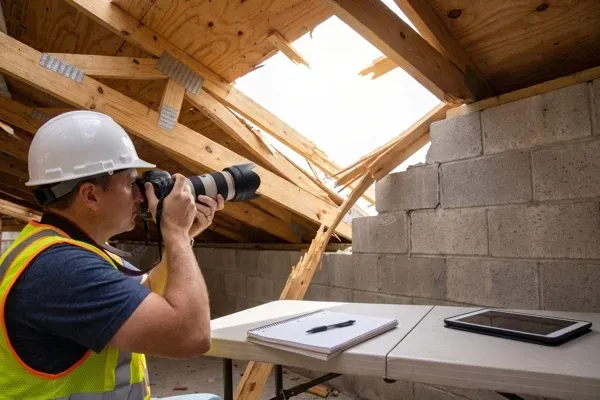
A licensed structural engineer inspects the building, determines what failed and why, distinguishes storm damage from pre-existing conditions, and writes a signed and sealed report describing the structural condition and the repairs the structure needs. That report is technical evidence. It doesn’t decide coverage, and it doesn’t set a settlement figure.
The distinction matters. An adjuster’s job is to apply a policy to a loss. An engineer’s job is to establish the physical facts the policy gets applied to. Documented properly, everyone works from the same record instead of competing opinions. Our post-storm structural assessment service exists to produce that record.
| Role | What they do | What they don’t do |
|---|---|---|
| Licensed structural engineer (PE) | Determines cause and extent of structural damage, defines the repair scope, signs and seals the report | Interpret your policy, negotiate a settlement, or advise on coverage |
| Carrier’s adjuster | Investigates the claim and applies the policy on the insurer’s behalf | Act as your representative |
| Public adjuster | Represents the policyholder in the claim (a separately licensed profession in Florida) | Perform engineering analysis or seal structural documents |
| General contractor | Prices and performs the repairs | Determine structural cause or issue an engineering opinion |
| Local floodplain administrator | Makes the substantial damage determination at permitting | Handle anything on the insurance side |
If you’re still deciding what kind of professional you need, our comparison of a structural engineer and a home inspector draws the same line for routine inspections.
Why does the cause of the damage matter more than the damage itself?
Because Florida ties coverage to cause. Under Fla. Stat. 627.4025, hurricane coverage means loss caused by windstorm during a hurricane, and it includes ensuing rain damage only where the windstorm first damaged the building and created an opening for water to enter. Standard property policies exclude flood, which is why the OIR figures above show flood exclusions closing one in five Helene claims without payment.
In Tampa Bay, that line is not academic. Hurricane Helene pushed 5 to 7 feet of storm surge inundation into Tampa Bay, and the St. Petersburg tide gauge recorded 6.31 feet above mean higher high water, breaking a record set at 3.97 feet by Hurricane Elena in 1985 on a station with data back to 1947 (NOAA National Hurricane Center, 2025). A lot of coastal buildings took wind loading and surge loading in the same event.
Separating those two load paths is forensic work. Uplift damage at a roof diaphragm, racked wall framing, and displaced connectors read very differently from scour at a footing, hydrostatic pressure on a slab, or debris impact at surge height. That’s the kind of analysis our forensic structural engineering and coastal engineering teams do, and it’s why we ask for a look at the structure before repairs cover the evidence.
“The building tells you what happened to it, but only if somebody reads it before the drywall goes back up. Once repairs start, the physical record of causation is gone.”
- Judian Duran, PE, StS-1
What goes into a post-storm structural engineering report?
A useful report is specific enough that another engineer could follow the reasoning. Ours typically covers the structural system and its condition, observed distress mapped to location, an opinion on cause with the supporting evidence, whether the structure is safe to occupy, and the repair scope needed to restore capacity. Photographs and measurements back every finding.
What it doesn’t contain is a coverage opinion. We won’t write that a loss “should be covered,” because that isn’t an engineering determination and a PE has no business making it. We describe the structure. Our article on what a structural inspection includes walks through the same methodology outside the storm context, and post-storm structural evaluation in Tampa covers the field process in detail.
One practical note: not every crack that appears after a storm is storm damage. Florida soils, thermal movement, and ordinary settlement produce cracking that predates any hurricane, and an honest report says so. That’s why we wrote a separate piece on which foundation cracks warrant concern.
How does the 50 percent substantial damage rule change your repairs?
Federal floodplain regulation defines substantial damage as damage where the cost of restoring the structure to its before-damaged condition equals or exceeds 50 percent of the building’s pre-damage market value (44 CFR 59.1). Cross that threshold and the building can’t simply be repaired as it was. It has to be brought into compliance with current floodplain requirements, which for many Tampa Bay properties means elevation.
The determination is made locally, at permitting, not by your insurer. Hillsborough County evaluates owner and contractor worksheets against the building’s market value from the Property Appraiser or an appraisal by a state-licensed appraiser (Hillsborough County). For flood-insured buildings, the Standard Flood Insurance Policy carries up to $30,000 in Increased Cost of Compliance coverage toward elevation, floodproofing, relocation, or demolition (44 CFR Part 61, App. A(1)).
A substantial damage finding changes the whole repair path, so it’s worth knowing early. If elevation is on the table, our guide to lifting a home before a flood lift explains what that project involves structurally.
What are Florida’s post-storm deadlines?
Short, and shorter than most owners expect. Notice of a hurricane claim must reach the insurer within 1 year of the date of loss, which for a hurricane is the date of landfall, and a supplemental claim within 18 months (Fla. Stat. 627.70132). The insurer has its own clock running in parallel.
| Requirement | Timeframe | Source |
|---|---|---|
| Insurer acknowledges a claim communication | 7 calendar days | Fla. Stat. 627.70131 |
| Insurer conducts physical inspection after proof-of-loss statements | 30 days | Fla. Stat. 627.70131 |
| Insurer pays or denies the claim after notice | 60 days | Fla. Stat. 627.70131 |
| Notice of an initial or reopened hurricane claim | 1 year from date of loss | Fla. Stat. 627.70132 |
| Notice of a supplemental claim | 18 months from date of loss | Fla. Stat. 627.70132 |
Deadlines aren’t the only reason to move early. Evidence degrades. Tarps go up, water dries, demolition starts, and the structural story gets harder to read every week. Call (813) 536-8002 or use our contact page if you need someone out quickly.
Where does engineering stop and insurance begin?
Here, clearly. We don’t tell you what your policy covers, what your hurricane deductible will be, how to respond to an adjuster, or what a claim is worth. Florida requires insurers to offer hurricane deductibles of $500, 2 percent, 5 percent, or 10 percent, applied on an annual basis across covered hurricane losses in a calendar year (Florida DFS) - and how that applies to your policy is a conversation for your agent, your carrier, or a licensed public adjuster.
For insurance questions, the Florida Department of Financial Services runs a consumer helpline at (850) 413-3089 (Florida DFS). What we bring is a principal with over a decade and 100+ projects of structural experience, PE licensure in Florida, North Carolina, Georgia, and Alabama, and StS-1 Structures Specialist credentials on Florida Urban Search and Rescue Task Force 3. Deployed structural assessment is not a sideline for us.
Not sure what you’re looking at yet? Our resources library collects our post-storm and coastal guidance, and our services overview shows what we assess across residential and commercial property.
Frequently Asked Questions
Does an engineer’s report guarantee my claim gets paid?
No, and any engineer who suggests otherwise is overstepping. A report establishes structural facts: cause, extent, and repair scope. Coverage decisions belong to your insurer under your policy, and Florida gives insurers 60 days after notice to pay or deny a claim (Fla. Stat. 627.70131). We document the building, not the claim.
Is Duran Structural a public adjuster?
No. We’re a licensed structural engineering firm. Public adjusting is a separate profession with its own Florida licensure, and representing policyholders in claims isn’t something we do or advise on. If you need that help, the Florida Department of Financial Services consumer helpline at (850) 413-3089 can point you to licensed options (Florida DFS).
My insurer already sent an engineer. Do I need my own?
That’s your call, and it depends on whether the findings match what you’re seeing. An independent structural assessment or peer review gives you a second technical opinion from an engineer with no relationship to either side of the claim. Peer review is standard practice in structural engineering generally, not a claims tactic.
Is storm surge damage covered under my hurricane coverage?
Generally no. Florida defines hurricane coverage as windstorm damage, with rain damage covered only where wind first created an opening (Fla. Stat. 627.4025). Surge and flooding fall under flood insurance. After Helene, flood exclusions accounted for 20 percent of Florida claims closed without payment (Florida OIR, 2025).
How soon after a hurricane should I get a structural evaluation?
As soon as the property is safe to enter and before repairs begin. Evidence of causation disappears once tarps, demolition, and drying start. Florida also bars claim notice more than 1 year after the date of loss (Fla. Stat. 627.70132), so the useful window is narrower than the legal one.
The bottom line
Hurricane structural damage claims turn on facts only an engineer can establish: what the structure did under load, why it did it, and what it takes to restore capacity. Documenting those facts early and independently means everyone involved is working from the same building. What happens next with your policy is between you, your carrier, and whichever licensed professional you choose.
If you own or manage Tampa Bay property that took structural damage in a storm, start with a post-storm structural assessment. Call (813) 536-8002 or reach us through the contact page. For cost and scope, see our guide to when you need a structural engineer in Tampa, or read more about our firm.
Consult a licensed engineer about your specific structure. This article is general engineering information, not legal or insurance advice.
Judian Duran, PE, StS-1 is the founder and principal structural engineer of Duran Structural, a boutique Tampa firm serving all of Florida and the Southeast. He’s a licensed Professional Engineer in Florida, North Carolina, Georgia, and Alabama with over a decade of experience across 100+ projects, and brings big-firm rigor earned over eight years as a project engineer at Thornton Tomasetti to a hands-on, owner-minded practice. As a StS-1 certified Structures Specialist on Florida Urban Search and Rescue Task Force 3, he leads Duran’s post-storm evaluation work, and he serves as Vice President of the ASCE West Coast Branch and president of the FSEA Bay Area chapter. He also sits on the ASCE 24 Flood-Resistant Design committee and is a contributing author to FEMA P-2345, the Building Designer’s Guide to Calculating Flood Loads Using ASCE 7-22 Supplement 2.
