
Seawall Engineer: 6 Warning Signs Your Wall Is Failing
By Judian Duran, PE, StS-1, Founder and Principal Structural Engineer at Duran Structural. Last updated August 2026.
Most waterfront owners find this hard to believe: there’s no minimum seawall design standard in the Florida Building Code. A 2024 policy study prepared for the Florida Department of Environmental Protection found that “the Florida Building Code and local building ordinances do not address specific design criteria for seawalls” (Florida DEP, 2024). Your wall was built to whatever standard the engineer of record applied, and after that, nobody checks it again.
So the visible warning signs matter. Below are the six conditions you can actually see, what each means structurally, how urgent it is, and where the line sits between a contractor patch and a job that needs a licensed seawall engineer. In Tampa Bay, that line is also a legal one.
Key Takeaways
- Toe scour is the failure the state keeps finding. A study for Florida DEP reported that “the collapse of numerous seawalls has been attributed to toe failure (scour at the base of the wall) resulting from inadequate embedment depth” (Florida DEP, 2024).
- Almost everything governing your wall’s condition is invisible. The same study notes integrity “is driven in large part by the unseen such as tie-rods, the depth of the wall,” puts design life at “usually 25 to 50 years,” and confirms Florida sets no minimum service-life standard.
- In Hillsborough County an engineer isn’t optional: Port Tampa Bay requires “signed and sealed drawings/plans” for all jurisdictional seawall applications (Tampa Port Authority).
What are the warning signs of seawall failure?
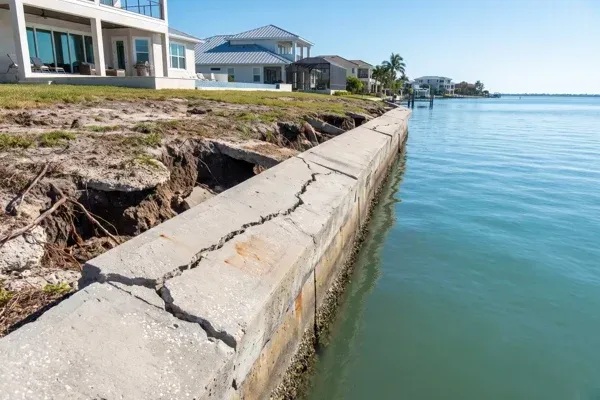
In our practice, six visible conditions account for most seawall distress calls: cracking or separation at the concrete cap, panels leaning waterward, sinkholes in the backfill, dry or missing weep holes, an exposed toe, and rust staining with spalling concrete at the splash zone. They don’t carry equal urgency. Use the table as triage: it won’t replace an inspection, but it’ll tell you whether you’re looking at maintenance or a call you should make this week.
| Warning sign you can see | Likely cause | Urgency | Who to call |
|---|---|---|---|
| Hairline cap cracks, no offset | Concrete shrinkage or early cap distress; often cosmetic | Monitor. Photograph, date it, recheck in six months | Marine contractor to seal; engineer if it widens |
| Wide, stepped, or offset cracks; cap pulling off the panels | Load transferring into the cap, often tieback or anchor distress | Weeks, not seasons | Licensed structural or coastal engineer |
| Panels leaning waterward, wall out of plumb, wavy alignment | Rotation, lost passive soil resistance at the toe, or anchor stretch | Urgent | Licensed structural or coastal engineer |
| Sinkholes, soft spots, or depressions behind the wall | Backfill escaping through joints, cracks, or a failed filter | Urgent, and a safety hazard | Licensed engineer, before any fill goes in |
| Weep holes dry after heavy rain, or none visible | Blocked or absent drainage; hydrostatic pressure on the land side | Weeks | Contractor to clear; engineer if the wall has moved |
| Bottom deepening at the wall face, footing or pile tips exposed | Toe scour reducing embedment depth | Immediate | Licensed engineer. Do not patch first |
| Rust staining, spalling, exposed reinforcing at the splash zone | Corrosion of embedded steel in the wet and dry cycling zone | Months | Engineer assessment of remaining section |
Why is toe scour the sign you can’t ignore?
Because the toe holds everything else up. The U.S. Army Corps of Engineers puts it without hedging: “Toe stability is essential because failure of the toe will generally lead to failure throughout the entire structure” (USACE EM 1110-2-1614, 1995).
A cantilevered wall stays upright because enough of it is buried in soil that isn’t going anywhere. The Corps notes toe scour “decreases the effective embedment of the sheetpiling and threatens toe stability,” and that seepage beneath a vertical wall worsens scour by reducing the effective weight of the soil. Boat wake, tidal currents, and storm waves all move that material, and once it’s gone the wall is a lever with a shrinking fulcrum.
Check it at low tide. If you can see the bottom of the panels, the footing, or a gap that wasn’t there last year, stop pricing cosmetic repairs. That’s the same category of problem as a structural assessment on a building.
What does a leaning seawall or cracked cap tell you?
Usually that the wall is rotating, and rotation is a soil problem as much as a concrete one. Florida DEP’s armoring study lists the recognized failure modes as flanking, structural failure producing “cracks, bulging or collapse,” material breakdown, overturning, overtopping with “loss of soil, tie-back anchor failure,” sliding, and seepage. Most announce themselves at the cap first.
Tiebacks are the part owners never see. On an anchored wall, steel rods run back into a deadman buried in the yard and carry a large share of the load. When those rods corrode, stretch, or lose anchorage, the wall leans and the cap takes forces it was never sized for. That’s why a cap separating from the panels is a different animal from a hairline crack. It’s the same reading exercise as foundation cracks and when to worry: the pattern and the movement tell the story, not the width.
“A seawall gives you almost no warning at the surface. By the time the cap cracks, the tiebacks or the toe have usually been losing capacity for years. That’s a soil and structure question, and it doesn’t get answered from a boat.” - Judian Duran, PE
What causes sinkholes and voids behind a seawall?
Soil leaving through the wall. A seawall retains fill, and that fill only stays put if the drainage path lets water out while holding sand back. The Corps describes the job precisely: “the filter assures drainage and retention of the underlying soil.” When a joint opens or the filter fabric tears or clogs, water leaving the backfill carries sand with it.
The result is a void you can’t see until the surface drops into it. Owners notice a soft spot near the cap, a paver that rocks, or a depression that returns after every hard rain. Filling the hole with sand is the most expensive mistake in this article: you’re feeding material into a wall that’s still leaking, and you’ve buried the evidence an engineer would use.
What about the weep holes? They relieve hydrostatic and hydrodynamic pressure on the land side. If yours stay dry after a heavy Tampa downpour, water isn’t getting out and the wall is carrying a load case it may never have been designed for. DEP’s study recommends Florida’s rules be updated to account for “drainage behind the armoring structure.”
When do you need a seawall engineer instead of a contractor patch?
In Hillsborough County the answer is usually “always,” and it’s a permitting requirement rather than a judgment call. Port Tampa Bay’s marine construction summary states that seawall construction, including replacement of an existing wall, “requires drawings/plans signed and sealed by a Florida Registered Professional Engineer” (Tampa Port Authority).
Note the scope. The minor work category covers “new seawalls less than 400 ft., or replacement/repair of seawalls of any length,” so a short run doesn’t exempt you. The City of Tampa’s residential seawall submittal list matches: a signed and sealed survey and wall section, plus an EPC permit and Port Authority approval (City of Tampa). Skipping it is costly, since unauthorized marine construction “requires three (3) times the normal TPA permitting fees and may require removal or restoration.”
There’s a federal layer too. Shoreline stabilization is one of five activity types authorized under State Programmatic General Permit VI, issued by the Army Corps’ Jacksonville District on July 27, 2021, letting DEP’s process carry the federal authorization for minor work (Florida DEP). On open sandy coast you may also sit seaward of the Coastal Construction Control Line, established in 25 Florida counties at “the upland or landward extent of the damaging effects of a 100-year storm event” (Florida DEP).
The practical rule: sealing a hairline crack or clearing a weep hole is maintenance. Anything touching the structure, the tiebacks, the toe, or the backfill needs an engineer, a permit, or both. That’s what our coastal engineering work covers, and it’s separate from a structural inspection on the house.
How long should a seawall last in Tampa Bay?
Plan on a design life of 25 to 50 years, and treat it as a target rather than a promise. DEP’s study defines design life as “an estimate of the number of years of useful life of the structure,” notes that “usually 25 to 50 years is employed for well-designed projects,” and states that Florida “does not specify a minimum standard for the service life.”
Local conditions move a wall within that band. Corrosion is the main enemy in brackish and salt water, and the Corps singles out the splash zone “where materials are subjected to continuous wet-dry cycles.” Boat wake in a narrow canal, undersized original embedment, a neighbor’s wall ending mid-block and letting erosion flank yours, and repeated surge all shorten the clock. If your wall is past 25 years, has no as-built drawings on file, and has never been looked at below the waterline, you’re in the group DEP described when it said condition and design “remain largely unknown until there is exposure or failure.”
Frequently Asked Questions
Can a marine contractor repair my seawall without an engineer?
Not for structural work in Hillsborough County. Port Tampa Bay requires “signed and sealed drawings/plans” for all jurisdictional seawall applications, and its minor work category covers “replacement/repair of seawalls of any length” (Tampa Port Authority). Sealing and cleaning are maintenance; structural work needs a licensed engineer and a permit.
Is a cracked seawall cap an emergency?
It depends on the crack. Hairline cracking with no offset is monitored. A wide, stepped, or offset crack, or a cap separating from the panels, points toward tieback distress and should be looked at within weeks. Florida DEP’s study lists “tie-back anchor failure” among the modes leading to seawall failure.
How do I know whether my seawall has tiebacks?
Often you can’t tell from the surface, which is the problem. DEP’s study notes wall integrity “is driven in large part by the unseen such as tie-rods, the depth of the wall,” and that as-built records frequently don’t exist. An engineer establishes wall type through targeted probing, underwater survey, and permit-record research.
Does homeowners insurance cover seawall failure?
Coverage for seawalls and other exterior structures varies widely and is often excluded or sub-limited, so read your declarations page rather than assuming. If a named storm damaged both the wall and the house, the documentation standard is the one in our guide to a hurricane structural damage insurance claim.
Should I inspect my seawall after a hurricane?
Yes, and specifically below the waterline. Surge and wave action drive toe scour, and USACE guidance is that failure of the toe “will generally lead to failure throughout the entire structure.” A wall that looks untouched from the yard can have lost real embedment. See our post-storm structural evaluation process.
Get the wall assessed before you commit to a repair
If you’ve spotted two or more signs from the table, the next step is an assessment, not a quote for a patch. We’ll establish what type of wall you have, what’s driving the movement, and what the condition actually calls for, so you aren’t paying to treat a symptom. Duran Structural is a boutique Tampa firm with over a decade of principal experience across 100-plus projects, licensed in Florida, North Carolina, Georgia, and Alabama.
A seawall is the one structure on your property where the failure mechanism sits almost entirely underwater or underground, so waterfront work punishes guesswork. Diagnose first. Call (813) 536-8002 or contact our team for a coastal assessment, and see our coastal engineering services for how we approach shoreline structures on residential and commercial property. Still weighing whether you need an engineer at all? Start with when to call a structural engineer, compare a structural engineer and a home inspector, then browse our resources.
Judian Duran, PE, StS-1 is the founder and principal structural engineer of Duran Structural, a boutique Tampa firm serving all of Florida. A licensed Professional Engineer in Florida, North Carolina, Georgia, and Alabama with over a decade of experience across 100-plus projects, he brings big-firm rigor, earned over eight years as a project engineer at Thornton Tomasetti, to coastal, historic, healthcare, and high-rise work. As a Structures Specialist (StS-1) on Florida Urban Search and Rescue Task Force 3, he leads Duran’s post-storm structural assessment practice. He also sits on the ASCE 24 Flood-Resistant Design committee and is a contributing author to FEMA P-2345, the Building Designer’s Guide to Calculating Flood Loads Using ASCE 7-22 Supplement 2.
This article is general information, not project-specific engineering advice. Consult a licensed engineer for your specific property and conditions.
